
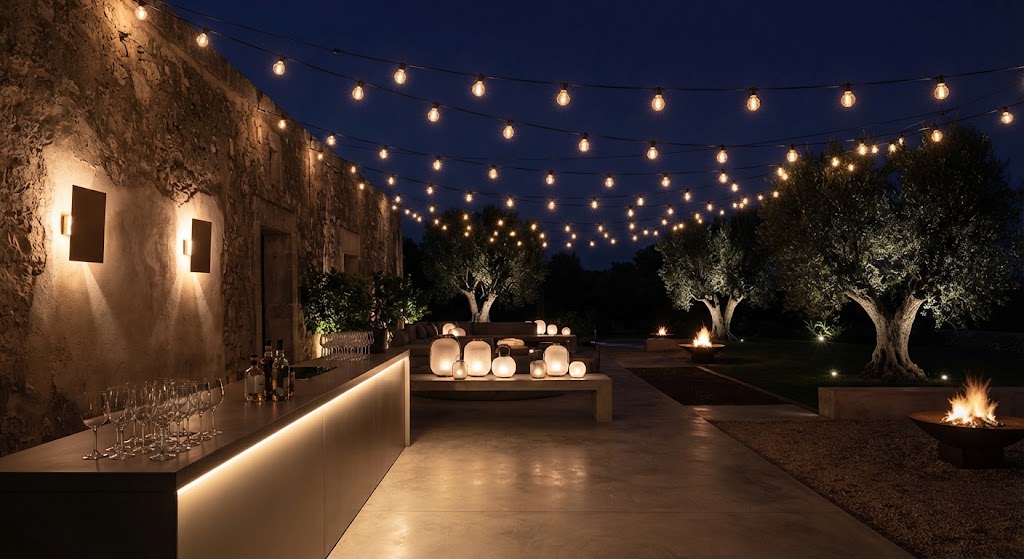
Have you ever taken photos at a party where the party lights looked beautiful in person but disappointing in pictures?
The string lights looked warm and inviting. The backyard felt cozy. The colorful lights created the perfect party atmosphere.
But when you checked your phone, the people were too dark, the bulbs were overexposed, or everyone's skin looked strangely blue, orange, or red.
The problem may not be your camera.
The real issue is that lighting that looks good to your eyes does not always photograph well.
Your eyes can adapt to a wide range of brightness levels, while a camera has to capture the scene within a limited exposure range. When bright party lights and relatively dark people appear in the same frame, your camera has to decide what to expose correctly.
That is why a party can look amazing in person but produce disappointing photos.
The good news is that you don't need professional photography equipment to fix it. You mainly need to understand where your light comes from, how bright it is, what color it is, and what job each light is doing.
In this article, we'll explain how to use party lights to create better-looking party pictures, from color temperature and brightness to background lighting, face lighting, flash, and outdoor placement.
Quick Answer: How Do You Make Party Lights Look Good in Photos?
The easiest answer is:
Don't use decorative party lights as your only light source.
Instead, combine four lighting functions:
Ambient Light + Face Light + Background Light + Accent Light
Ambient light creates the overall atmosphere.
Face light keeps people visible.
Background light adds depth.
Accent light adds color and visual interest.
For many indoor and outdoor social settings, warm white light around 2700K–3000K creates a comfortable atmosphere. LightsLux also recommends warm white lighting for inviting outdoor environments and emphasizes the importance of consistent color temperature.
The goal isn't to make the whole party brighter.
The goal is to make people, space, and atmosphere visible at the same time.
If you remember only one rule:
Light the people, not just the decorations.
Why Do Party Lights Look Better in Person Than in Photos?
Your eyes and your camera don't process light in exactly the same way.
Imagine an outdoor party with bright string lights overhead, a dark backyard, and guests standing underneath the lights.
Your eyes can simultaneously perceive the glowing bulbs, people's faces, furniture, trees, and surrounding darkness.
A camera has to choose an exposure.
If it exposes for the bright bulbs, faces may become too dark.
If it exposes for the faces, the bulbs may become extremely bright and lose detail.
This is especially important when using flash. B&H Photo Video explains party photography as a balance between flash exposure for the subject and ambient exposure for the background and surrounding environment.
So instead of asking:
"How bright should my party lights be?"
ask:
"How bright should the people be compared with the background?"
That question leads to much better lighting decisions.
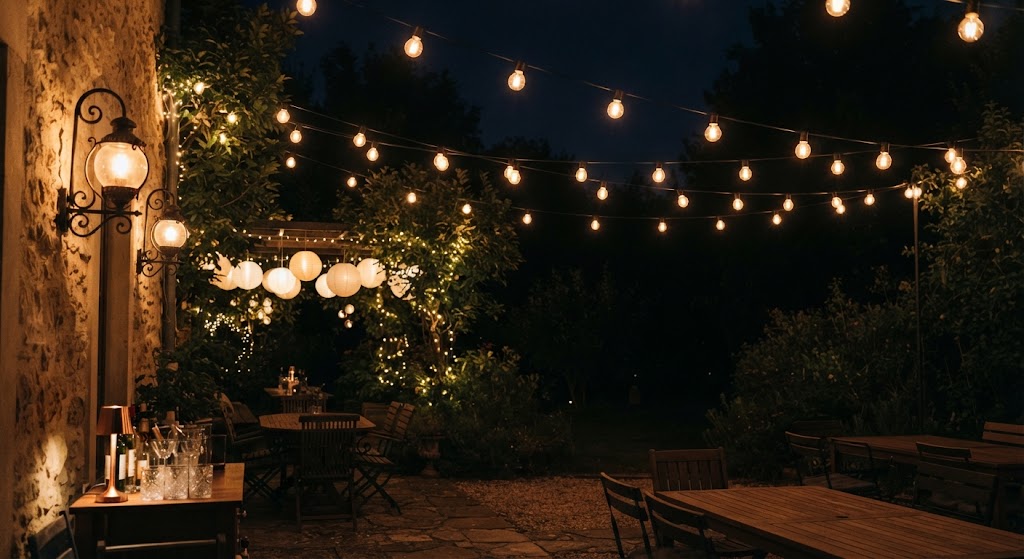
1. Don't Rely on Party Lights Alone to Illuminate Faces
String lights are excellent for atmosphere, but they aren't always effective at lighting people's faces.
A string of bulbs may be hanging several feet above someone's head. The bulbs look bright, but the light reaching their face may still be relatively weak.
This can create:
Dark eye sockets
Shadows under the nose
Dark faces against bright backgrounds
Uneven skin tones
Silhouettes
Lost facial detail
The solution isn't necessarily to replace your party lights.
Instead, add a small amount of softer light closer to where people are standing.
You can use:
Wall lights
Diffused lamps
Table lamps
Portable lights
Soft outdoor fixtures
Indirect reflected light
A dedicated light near the photo area
LightsLux's article on layered wall lighting explains how ambient, task, and accent lighting can work together to create a more balanced environment. It also recommends using multiple lighting levels rather than relying on one overhead source.
The principle is simple:
Party lights create the mood.
Supplementary lighting makes the people visible.
2. Use Soft Face Lighting Instead of Simply Adding More Brightness
When someone's face is too dark, your first instinct may be to add a brighter light.
But brighter isn't always better.
A powerful light pointed directly at someone's face can create harsh shadows, flatten facial features, and destroy the atmosphere created by your party lights.
Instead, try softer, controlled illumination.
For example:
Place the light slightly to the side.
Diffuse the light when possible.
Bounce light from a nearby neutral surface.
Avoid putting the brightest source directly at eye level.
Keep the light close enough to illuminate faces without dominating the scene.
Nikon's lighting tutorials demonstrate how ambient light and controlled flash can be combined to shape a scene while preserving its existing mood.
Think of face lighting as supporting light, not the main attraction.
3. Put Some Party Lights Behind Your Guests
One of the easiest ways to make party photos look more interesting is to use party lights as background lighting.
Compare these two scenes:
Scene A
A person stands in front of a completely dark backyard.
Scene B
A person stands in front of warm string lights, softly illuminated trees, and a glowing patio.
Scene B has much more depth.
This is why party lights work particularly well behind:
Seating areas
Dining tables
Pergolas
Patios
Fences
Trees
Photo backdrops
Better Homes & Gardens highlights outdoor string lights as a way to define patios, pergolas, dining areas, trees, and other outdoor features.
For photography, this placement has another advantage:
The lights become part of the composition instead of simply illuminating the scene.
4. Use Layered Lighting Instead of One Bright Source
A common party lighting mistake is trying to illuminate everything with one powerful fixture.
That often creates a flat-looking environment.
A better approach is layered lighting.
Layer 1: Ambient Lighting
Creates the overall atmosphere.
Examples:
String lights
Ceiling lights
Lanterns
Wall lights
Layer 2: Face or Task Lighting
Provides enough illumination for people to eat, talk, and appear clearly in photos.
Examples:
Dining lights
Wall lights
Diffused lamps
Portable lights
Layer 3: Background Lighting
Adds depth.
Examples:
String lights behind guests
Tree lighting
Decorative lanterns
Architectural lighting
Layer 4: Accent Lighting
Adds color and visual focus.
Examples:
RGB lights
Uplights
Decorative LEDs
Landscape lighting
LightsLux's outdoor lighting placement tips similarly emphasize choosing lighting according to the function of each outdoor area rather than simply increasing brightness.
The result is more natural:
Good party lighting isn't one bright light. It's several controlled light sources doing different jobs.
5. What Color Temperature Is Best for Party Lights?
Color temperature is one of the most important factors in party photography.
It is measured in Kelvin (K).
Generally:
2200K–2700K: Very warm, amber-like
2700K–3000K: Warm white
3500K–4000K: Neutral white
5000K+: Cool white/daylight-like
For many social environments, 2700K–3000K warm white creates a relaxed and welcoming atmosphere.
However, consistency is often more important than choosing one exact number.
Imagine a party with:
2700K string lights
5000K ceiling lights
Blue RGB lights
Purple LEDs
Smartphone flash
Your eyes may see an exciting environment.
Your camera may record several competing color casts.
B&H also notes that multiple light sources can introduce different color casts into party photographs.
A practical rule is:
Warm white ambient light + controlled colored accents
usually works better than mixing several unrelated white-light temperatures.
6. Use RGB Party Lights as Accents, Not Face Lighting
RGB party lights can add energy and personality, but strong colored light directly on someone's face can make skin tones look unnatural.
For example:
Blue can make skin appear cold or pale.
Red can make skin look overly saturated.
Green can create an unnatural complexion.
Purple can make natural skin tones difficult to reproduce.
You don't need to eliminate colorful lighting.
Instead, move stronger colors toward:
Background walls
Trees
Architectural features
Dance floors
Decorative areas
Photo backdrops
Then keep the primary light on people's faces closer to a natural or warm-white tone.
Nikon's color-control techniques show how accent colors can be deliberately used to shape mood and depth.
This makes RGB lighting a design tool rather than a problem.
Common Party Lighting Mistakes That Ruin Photos
Mistake 1: Using Only String Lights
They create atmosphere but may not provide enough facial illumination.
Better: Keep them and add soft supplementary lighting.
Mistake 2: Using One Extremely Bright Floodlight
It may illuminate everything but can flatten the scene.
Better: Use several moderate sources with different functions.
Mistake 3: Putting RGB Lights Directly on Faces
Strong colors can distort skin tones.
Better: Use saturated colors mainly in the background.
Mistake 4: Mixing Too Many Color Temperatures
Warm, cool, blue, and green light can compete with each other.
Better: Choose one main white-light temperature.
Mistake 5: Making Every Area Equally Bright
Uniform brightness removes visual hierarchy.
Better: Let some areas remain darker so important areas stand out.
Mistake 6: Testing Only Before Sunset
The lighting will change once natural light disappears.
Better: Test at approximately the same time as the actual party.
The 30-Second Party Lighting Formula
If you remember only eight things, remember these:
1. Light the people.
Make sure faces are visible.
2. Light the background.
Give the camera something interesting behind the subject.
3. Keep your main color temperature consistent.
Warm white is often a strong starting point for social environments.
4. Use color as an accent.
Don't let RGB lighting dominate every face.
5. Control brightness.
More lumens don't automatically create better photographs.
6. Control glare.
Visible bulbs can be beautiful; uncontrolled bulbs pointed into the lens are distracting.
7. Create layers.
Use different heights and lighting functions.
8. Test after dark.
Your eyes may like the setup, but your camera needs to like it too.
Final Thoughts: The Best Party Lights Aren't Necessarily the Brightest
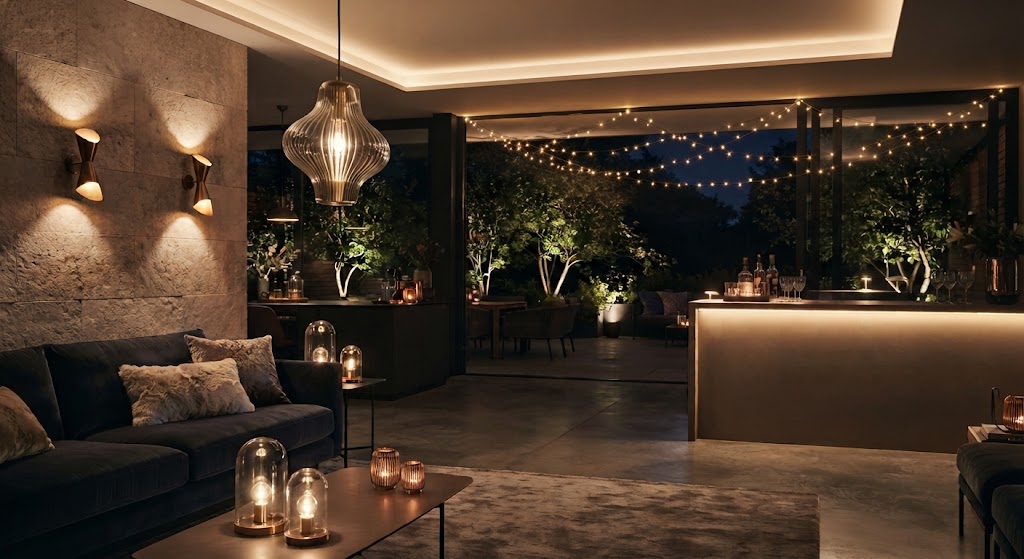
The best party photos rarely come from simply adding more light.
They come from using light intentionally.
Your decorative party lights should create atmosphere.
Your softer face lighting should make people visible.
Your background lights should create depth.
Your accent lights should add personality.
And your camera should be able to capture all of those elements without being overwhelmed by any one of them.
So instead of asking:
"How many party lights should I add?"
ask:
"What job does each light need to do?"
That small change in thinking can transform the way you plan party lighting.
You don't need to make the entire space equally bright. You need to create layers, contrast, depth, color, and focus.
And that's what makes party lights look good not only in person, but also in the photos people keep long after the party is over.
FAQ: Party Lights and Photography
Why do my party lights look good in person but bad in photos?
Because your eyes can adapt to a wider range of brightness than a camera. Bright bulbs combined with dark faces often create exposure problems.
What color temperature is best for party lights?
For many relaxed social environments, 2700K–3000K warm white is a good starting point. More importantly, keep your main white-light sources consistent.
Should party lights be in front of or behind people?
Ideally, both. Use soft light near the front to illuminate faces and decorative party lights behind people to create depth.
Are RGB party lights good for photos?
Yes. They work particularly well as background or accent lighting. Avoid using intense saturated colors as the primary light on people's faces.
How bright should party lights be?
Bright enough to provide the atmosphere and visibility you need, but not so bright that they create glare or overpower the scene.
Do I need professional photography equipment?
No. A modern smartphone can produce excellent party photos when the lighting environment is balanced.
Should I use flash at a party?
Only when needed. If you use flash, balance it with ambient party lighting so the background doesn't disappear.
How can I make outdoor party lights look better in pictures?
Use multiple layers: overhead string lights, soft face lighting, background lighting, pathway lighting, and accent lighting.
Why are people dark when there are many party lights around them?
Because decorative lights may be illuminating the background rather than the people. Add a softer light closer to face level.
Can too many party lights make photos worse?
Yes. Too many bright sources, competing colors, or uncontrolled glare can make a photograph visually confusing.
What is the most important party lighting photography rule?
Light the people, not just the decorations.
Aktie:
Control Methods for Ceiling Fans With Lights: Which One Is Right for You?
How to Clean and Maintain a Textile Lamp Shade: A Practical Guide to Dust, Stains, Washing, and Long-Term Care